Monthly Archives: January 2010

Professionalism and SPOT tagging of great white sharks

Yesterday, Underwater Thrills: Swimming with Sharks a commentary on the need for standardizing protocols for SPOT (Smart Position and Temperature) tagging of breeding-age great white sharks at Isla de Guadalupe. Accompanying the commentary was the video seen below.

It’s hard to argue with the points made over at the Underwater Thrills blog, after watching the video. The seawater hose that is needed for the shark to continue to breathe is all over the place in the video, instead of in the sharks mouth passing water through its gills. Another apparent major fault seen in this video is the lack of proper support for the shark, listed as weighing over 1,000 kg (2,205 lbs) in the video’s information. The coup de grâce for the video occurs when one of the researchers loses balances and ends up flipping off the stern of the research vessel, bouncing off the head of the shark and landing in the water. Fortunately, the individual did not seem to be seriously injured by the fall. The events in this video illustrate the risks to both the humans and the sharks involved in this technique.

While there is little doubt that those involved with SPOT tagging have the intention of helping great white sharks by gaining more knowledge about the species, the risks involved in operations like the one seen in the video seem like they create a potential “more harm than good” scenario. Here’s to hoping that future endeavors involving SPOT tagging can follow a methodology that is safer for both researchers and sharks alike.

Stunning shark footage from Cocos and Malpelo Islands

Along with stumbling across Blue Sphere Media’s shark finning video, I also checked out some of their other shark footage. For a more positive themed shark video, check out their Realm of the Shark footage from Cocos Island (Costa Rica) and Malpelo Island (Colombia), which includes some great footage of schooling hammerheads.

Blue Sphere Media shark finning video

A pirated version of Blue Sphere Media’s Unnatural Selection – Shark Finning on the Frontier video recently popped up over on YouTube. I hadn’t seen this video before, so I tracked the original down through Blue Sphere Media’s website and their Vimeo channel. The video seen below features some powerful imagery of finned sharks. From a production standpoint, the video gets an A+. Unfortunately, the video suffers from “magic number syndrome” (both the “100 million” and “90% decline” estimates make appearances in the video). The footage in the video alone is enough to make a strong message about shark finning, but when accompanied by “statistics” that have no scientific evidence behind them, the message becomes diluted. The problem of shark finning is real, as evidenced by the footage in the video, so why not use some “real” numbers (not to be confused with the real numbers you learned about in 5th grade during Mrs. Walker’s math class) to accompany this footage?

Warning: Video contains footage of discarded finned shark carcasses and severed shark fins.

Study indicates virgin shark births result in viable offspring

According to a press release at Science Daily, research published on January 25, 2009 in the Journal of Heredity shows that long-term survival of shark pups born of virgin mothers is possible. Dr. Kevin Feldheim of The Field Museum, has confirmed through genetic testing that two white-spotted bamboo sharks (Chiloscyllium plagiosum), now five years of age, were born to a virgin female shark. This is the first documented case of multiple shark births to a virgin mother, in which the offspring survived.

Feldheim’s analysis of comparisons between several sections of the genome of the shark pups and the mother shark indicated that all of the genetic material passed on to the pups was from the mother shark. Further analysis of more than a hundred additional regions of the genome, performed by Dr. Paulo Prodöhl and Séan Fitzpatrick of Queen’s University Belfast (Belfast, UK) confirmed Feldheim’s findings and also showed that the pups did not share all of their mother’s genetic material indicating that the shark pups were not “true clones” of their mother.

Expedition New England’s Scott Tucker on shark conservation

Scott Tucker, whom I can only describe as the Mr. Rogers (minus the cool puppets like King Friday) of public access wildlife television, was recently interviewed on Connecticut’s WTNH8 about his “Last Blue Shark” program and shark conservation, in general.

Tucker addresses the shark fin industry and the impact that is having on global shark populations. Tucker suggests ways that the audience can contribute to shark conservation efforts. Unfortunately, while discussing the shark fin industry, Tucker not only references the “100 million” magic number but also goes on to claim that 100 million is a conservative estimate and that “they believe it is even more.” While I certainly support Tucker’s good intentions, I believe that using “statistics” that have no scientific research behind them is potentially more harmful to shark conservation efforts than helpful. Within the past few months, the unsubstantiated claim of “100 million shark killed annually” has been used as a platform to discredit shark conservation efforts. In order for conservation efforts to be taken seriously, those promoting these efforts would be better served using the estimate of 26 million to 73 million sharks killed commercially each year, which is backed up by research (Clarke et al. 2006)

In addition to discussing shark finning and promoting conservation awareness, Tucker also plugs his latest episode of Expedition New England, “Last Blue Shark.” Expedition New England is a public access wildlife show which airs throughout Connecticut, as well as a few other localities (including Melbourne, Australia, believe it or not).

ABC Feature on Grey Nurse Shark conservation

Australia’s ABC network’s Triple J TV: HACK recently featured a story about the conservation of grey nurse sharks (Carcharias taurus) on the east coast of Australia. Grey nurse sharks (also known as Sand Tiger Sharks, and Spotted Ragged-Tooth Sharks) are reaching critically endangered levels on Australia’s east coast, according to the report. Despite being a protected species, conservationists believe that many of the sharks are still being accidentally hooked by fisherman.

Conflicting views are presented on how to protect and preserve grey nurse shark populations particularly along the coast of New South Wales. Options that are addressed are stricter fishing bans and artificial breeding of the species.

While I don’t know what the ideal solution to the problem is, Nicky Hammond’s assessment of the artificial breeding option makes sense to me. If the cause of the dwindling numbers of this species is not directly addressed, then breeding more sharks is just going to result in more of them being accidentally hooked. Artificially breeding grey nurse sharks would simply be a case of treating the symptoms without delivering a cure.

John “Chip” Scarlett’s “Save the Shark” race car unveiled

SpeedWorks R&D and Chip Scarlett's Save the Shark race car.

According to Mustang Challenge, SpeedWorks’ Mustang Challenge Race Team unveiled its “Save the Shark” race car on January 12, 2010. The car features an image of a young female great white shark on each side of the car. The shark image was photographed by the car’s driver and well-known underwater photographer, John “Chip” Scarlett. Scarlett shot the photo at Isla de Guadalupe in 2005. Scarlett’s “Save the Shark” car will make its first official track appearance in March during tests at the Virginia International Raceway, in Alton, VA.

The “Save the Shark” car will help to promote awareness about shark conservation efforts and will be adorned with the Shark Savers logo, in addition the great white shark image.

Scarlett’s photo essay, “Loving Sharks” earned him Ocean Geographic’s Underwater Photography Journalist award for 2009. Scarlett’s “Save the Shark” race car is another great and innovative example of responsible way to promote shark awareness. Kudos to Mr. Scarlett. If you’d like to learn more about John “Chip” Scarlett, check out JohnScarlett.com.

Amazing Great White Shark Sculptures by Bill Wieger

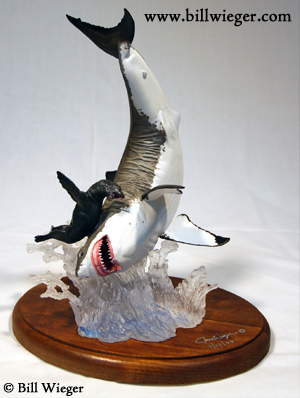
Not too long ago, I stumbled across a photo that somebody had posted one of my Facebook shark groups of an amazing great white shark sculpture, which I assumed to be from a museum. After doing a little digging and Google-ing (or is it Googling?), I managed to find the website of Bill Wieger, the amazing sculptor behind the the artwork. As it turns out, several of these incredible white shark sculptures are available for purchase through Wiegers’ online store. To top it all off, a portion of the sales from these awesome sculptures goes to the Guadalupe Island Conservation Fund.

Mystery 1, an amazing great white shark sculpture by Bill Wieger.gallery page.

The attention to detail in these white shark sculptures is stunning.

Mystery 1, an amazing great white shark sculpture by Bill Wieger.


A sculpture of a great white shark breach by Bill Wieger.


In addition to be an artist, Wieger is also a shark diver. He believes strongly in animal rights and conservation. Along with the contributions to the Guadalupe Island Conservation Fund, Wieger donates proceeds from some of his other wildlife sculptures to the Dian Fossey Gorilla Fund, and to WildAid.

In addition to his white shark sculptures, Wieger also offers resin shark teeth cast from original white shark and Megalodon teeth. Wieger also has a selection of shark posters available.

If you’d like to see more of Bill Wieger’s work, or if you’re interested in purchasing one of his works of art, check out his website at www.billwieger.com.

All photos courtesy of Bill Wieger.

Rogue sharks to be hunted down, shot in the head, and have spine severed?!?!

File this one under “over the top” response. According to Perth’s The Sunday Times, Western Australia Government’s Shark Hazard Committee has revealed revealed a plan of attack for dealing with “rogue sharks.”

According to Tina Thorne, WA Department of Fisheries strategic compliance manager, the series of actions for dealing with rogue sharks would involve hooking an offending shark on a baited drumline, hauling it aboard a boat, shooting it in the head, and then “severing its spinal cord and bleeding it out.” Thorne stated that these measures would be a “last resort” and only take place in extreme circumstances involving a rogue shark attacking a human and continuing to pose a significant threat to humans, AND the attacking shark would have to be positively identified. Thorne also stated that since white sharks are a protected species that “a special exemption from the law was required by Fisheries Minister Norman Moore to kill one.”

Great white sharks are a protected species in WA, and special exemption from the law would be required to hunt one down.


In 3 of the last 4 fatal shark attacks in WA, the shark responsible was never spotted. Only in the case of an attack on Brian Guest did the shark remain in the area after the attack. According to The Sunday Times article, Guest’s family was angered by the Shark Hazard Committee’s recent talks of killing sharks. A friend of the Guest family said that Guest’s wife and son stood by the idea that “sharks belong in the marine environment and should not be harmed.”

While I certainly believe that protecting humans from shark attacks is a serious and important issue. The idea of hunting a specific shark down, shooting it in the head, severing its spine, and bleeding it out seems so ridiculous that I would expect to find the idea in a really bad shark-themed horror movie. Instead, we find the idea coming from a government committee assigned with the task of dealing with real-world shark attacks. Even Ms. Thorne’s comments seem to indicate that the circumstances that would result in this method of response ever occurring seemed highly unlikely. Based on The Sunday Times article it seems like the only time these measures would be considered would be if a shark similar to the one in a certain famous shark movie showed up, attacked a human, and then continued to terrorize a beach area. I guess anything is possible, but I wonder why there was no mention of hiring a local crusty shark hunter to get the job done. I guess they didn’t want him interrupting the Shark Hazard Committee meeting by scratching his fingernails on the chalkboard.