Monthly Archives: August 2009

Dispelling the fear that Shark Week is selling and circumventing ignorant reporting

Rockford Illinois’ WREX Channel 13 ran an interview with Shark Diver Magazine’s Thomas Sergent yesterday. Sergent attempted to dispel the fear campaign that Discovery Channel has been serving up with this year’s Shark Week. (WARNING: The video does feature a few brief scenes of finning and a couple of shots of dead white sharks)

Sergent’s message was conservation-oriented and focused on how sharks have more to fear from humans, than we have to fear from them, based on the number of sharks killed annually by humans. However, that didn’t stop reporter, Bob Schaper, from interjecting an utterly ignorant statement into his interview with Sergent, which basically undermined the very message Sergent was trying to convey…


“Let’s face it. There are some sharks that like to gnaw on you, and, you know, just like drag you down and eat you, and chomp on you.”

There really isn’t any excuse for statements like this in what is supposed to be an objective news report. Not only does the statement reflect a sense of bad reporting, it is counterproductive to the intended message that Sergent was trying to communicate. The sheer lack of common sense of the statement makes me wonder if Schaper was playing “devil’s advocate” and began the statement with something to the effect of, “What do you say to people who think…” and that part was edited out. That scenario would at least make some sense.
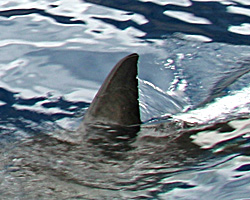
White shark sighting in the Gulf of Mexico?

The dorsal fin of a white shark. Fishermen in the Gulf of Mexico witnessed a similar sight on July 25.

The dorsal fin of a white shark. Fishermen in the Gulf of Mexico witnessed a similar sight on July 25.

According to the article, “Great White Shark Sighted Near Orange Beach”, the captain and crew aboard Chipper’s Clipper witnessed what they believed to be a great white shark on July 25. The shark was seen about 40 miles southeast of Orange Beach, Alabama in the Gulf of Mexico. Captain Chip Day first spotted the shark about 200 feet from the boat. He initially thought that it was a mako, but as it got closer, he and fisherman, Joe Pruett, “were able to observe the jagged line separating the gray from the white on the shark’s body. It was then they realized they’d just had a close, rare encounter with a Great White Shark in the Gulf of Mexico.”

Pruett, who had served in the Navy and spent time in the Pacific, said he had seen a number of great white sharks, and the shark they witnessed in the Gulf “looked just like” the white sharks he had seen during his time in the Navy. Day, who has been fishing in the Gulf for 30 years, had seen numerous mako and bull sharks, but this was the first time he’d ever had an encounter with a white shark.

A picture of the shark’s dorsal fin, as well as, a shot of the shark taken from the surface are featured with the original article. Was this a rare encounter with a great white in the Gulf? Check out the pictures and the story to see for yourself.

Is this “putting all of your media weight” behind shark conservation?

Above is the currently featured promotional video for Shark Week from Discovery Channel’s official YouTube page. It starts off with a series of shark attack depictions that rival those found in the movie, Jaws. If Discovery Channel is truly committed to putting “all of their media weight” behind the effort “of educating viewers about the plight of sharks and encouraging them to take action,” as Discovery Channel president, John Ford claims, why do they continue to feature promotional videos that focused predominantly on shark attacks on humans. Did I miss the conservation angle in this video?

CBS segment on “saving sharks”

The Early Show on CBS ran the video segment below this morning in conjunction with Discovery Channel’s Shark Week. The segment is loaded with all the typical shark cliches that often accompany mainstream media reports, including Jaws theme music, the science and technology correspondent referring to himself as bait, and the entire morning crew getting a good laugh in about sharks having “a tough PR problem.” While the lead-in to the video mentions sharks being endangered, the focus of the segment doesn’t seem particularly rooted in conservation efforts, and the light-hearted attitude on the part of the crew back in the studio at the end of the segment really doesn’t convey to me that those involved with the show treated the declining shark population issue with much serious thought.

The segment is not completely without merit, in terms of shark conservation, Andy DeHart, of the National Aquarium, notes that 250,000 sharks are killed daily, and he discusses the impact that losing sharks would have on the marine ecosystem. Stuart Cove also brings up how the experience of diving with sharks can change opinions and attitudes about sharks. Although, with the controversy going on with shark diving in the Bahamas, this Tiger Beach footage in the segment might also drum up more criticism from those opposed to shark diving.

A text-based version titled, Making A Case For Saving The Shark, also appeared online today.

A pair of shark attacks over the weekend

According to West Palm Beach, Florida’s WPTV.com, a Florida teen was bitten by a bull shark on Friday while spear-fishing in the Bahamas. Derek Mitchell was spear-fishing off Spanish Cay with his father and some neighbors. One of the other spear-fishermen had speared a fish, which they believe attracted the shark’s attention. The bull shark approached Mitchell but initially turned away, before returning and biting his lower leg, puncturing his Achilles tendon. Mitchell was rushed to a local hospital and later flown to St. Mary’s Hospital in West Palm Beach for surgery. Mitchell is expected to recover from the attack, according to the report.

In other shark attack news from the weekend, New Orlean’s The Times-Picayune article, Coast Guard medevacs man bitten by shark in Breton Sound, reports that, on Saturday morning, a fisherman was bitten in the leg by a shark. The victim was fishing about 65 miles southeast of New Orleans, in Breton Sound. The victim was airlifted from the scene by a Coast Guard MH-65C dolphin rescue helicopter and taken to New Orleans, where he was transported to University Hospital. The victim, from Mississippi, had not been identified, and the report listed his condition as unknown.

The Coast Guard has posted this video footage of the rescue.

Update (08/03/2009): WWL.com is reporting that the victim of the shark attack in Louisiana is 62-year old Chris Haynes. Haynes was bitten as he was wading in the water, while fishing in Breton Sound. According to Coast Guard Lt. John Egan, the shark “took off about half of his foot.” Egan also said that Haynes is “doing okay” and was to undergo surgery today (08/03) “to help fix up his foot and his leg.”

Here’s to hoping for a speedy recovery for both Haynes and Mitchell.

Renowned chef, Alice Waters, makes No Shark Fin Pledge

The No Shark Fin Pledge discourages the serving and consumption of products made with shark fins

The No Shark Fin Pledge discourages the serving and consumption of shark fin products

In a press release from The Humane Society of the United States, it is being reported that renowned chef and author, Alice Waters, has signed The International Humane Society’s No Shark Fin Pledge, which reads…

I pledge to help protect the world’s oceans by committing never to consume or serve shark fin or any product containing shark fin.

Continue reading

Media outlets reporting false shark attack fail to follow up with the true story

It’s been over a week since an incident involving an 11-year-old girl being bitten by a bluefish was falsely reported as a shark attack by multiple media outlets. Within less than 24 hours after the “story” broke, an AFP release revealed that “maritime experts later concluded that the bite suffered by the girl was too small to have been caused by a shark and was compatible instead with the marks that would be left by a bluefish.”

False accusations against a blue shark persist.

False accusations against a blue shark persist.

While it’s not uncommon for details of breaking news to be sketchy, if not entirely inaccurate, most media outlets tend to follow-up on a story when it turns out the story has been falsely or incorrectly reported. However, that doesn’t appear to be the case with the following publications:

Continue reading