Author Archives: George Probst

About George Probst

George Probst is an award-winning American photographer best known for his underwater great white shark photography at Isla de Guadalupe. In addition to his work underwater, Probst travels to schools, businesses, and communities for public speaking events to discuss the importance of sharks and ocean conservation.

Coast Guard issues shark advisory

The U.S. Coast Guard has issued a shark advisory for boaters in northeast waters.

The Associate Press is reporting that the Coast Guard has issued an advisory for boaters off northeast coast of the U.S. The article features several quotes from Al Johnson, the 1st Coast Guard District’s recreational boating specialist. There is no mention of Johnson’s expertise on white shark behavior, although the article does quote him on the subject. While Johnson does say that predation is generally not a concern for boaters and paddlers, he goes on to state…

“But I have no doubt that a great white shark that swims into your comfort zone would surely find a splashing paddle or dangling hand inviting. I also expect that same passing shark would spend little time differentiating between boater, paddler and prey.”

While it’s certainly prudent (for multiple reasons) to make boaters aware of the presence of white sharks in the area, the statements from Johnson seem to be a bit off-base. There are multiple first-hand accounts of people kayaking around large white sharks without the “splashing of a paddle” causing aggressive behavior from the sharks. The most well-known white shark encounters involving kayaks was documented by Michael Scholl and Thomas Peschak for Africa Geographic.

That being said, just because other people have kayaked with white sharks without incident does not necessarily mean that it’s something that is recommended for everybody to do. In fact, just last year there was a case of a kayak being bumped by a white shark in Australia that resulted in the kayaker being tossed into the water. The kayaker was unharmed and swam to a nearby boat.

However, to say there is “no doubt” that a shark would consider a dangling paddle “inviting” or spend little time differentiating between prey and a boater/paddler is a fairly bold statement. Research and observed behavior of white sharks has shown that white sharks can often be very discriminating about targeting prey during a predation event.

So, while Johnson does offer some sound advice to boaters on some levels, his rationale behind the advice is somewhat questionable, in my opinion. Should the public be aware that white sharks are in the area? Of course, but the information regarding the presence of these animals should not be accompanied by conjecture that seems to be in stark contrast to available research and observed behavior of white sharks.

At the end of the day, white sharks are large predatory animals, and from that respect a level of caution should always be taken in their presence, as there is certainly a level of danger associated with them. However, research has shown that they are also not the mindless attacking machines of horror movies and folklore who attack anything in sight. It is important for those who might encounter these animals to understand that, in order to avoid a panicked response, so that encounters can be addressed with common sense and level-headed thinking.

Here’s to a safe holiday weekend for all of those celebrating Independence Day this weekend, whether you be in the water or on the land.

Boston Globe columnist expresses fear over great white sharks

Great White Shark image

The presence of white sharks in the Cape Cod area is expected again this summer.

Boston Globe columnist Brian McGrory’s “State’s little white lie” addresses what the author appears to believe is an attempt by Massachusetts state officials to downplay concern over the presence of great white sharks in the Cape Cod area. McGrory likens an announcement from Ian Bowles, state secretary of environmental affairs, and Dr. Gregory Skomal of Massachusetts Division of Marine Fisheries to the attempted cover-up of a shark attack by the fictional character, Mayor Vaughn, from the movie “Jaws.” The announcement from Bowles and Skomal informed the people of Massachusetts that there was nothing to fear from great white sharks in the area, when it comes to visiting Massachusetts beaches over the upcoming holiday weekend.

Clearly, McGrory does not agree with this statement, but he offers little in the way of any kind of scientific evidence as to why this announcement should be viewed with skepticism by the public, save for references to a Google search, regarding white shark births and information from Answers.com (which is a user-submitted wiki, often lacking any references) regarding the maternal nature of white sharks. The references to white shark births were included as a result of McGrory expressing concern over the young white shark that was tagged last week in Stellwagen Bank last week.

McGrory’s logic seems to be that if a young white shark is present in Massachusetts’ water, then there is potential for other white sharks, including the shark’s mother and possible siblings, to be in the same general area. While this line of thinking isn’t necessarily flawed, the idea that swimmers are at risk due to the sighting of a young white shark 20 miles off the coast could certainly be considered questionable.

McGrory’s piece is undoubtedly tongue-in-cheek at times, but the overall message is that he believes beach-goers in Massachusetts are in danger if they go swimming. McGrory seems fairly convinced of this danger to the point that he calls into question the sincerity of Dr. Greg Skomal and his stance on the safety of swimmers. McGrory goes so far as to pick apart the semantics of Skomal’s voicemail message which states his is “in the field,” to which McGrory remarks that he prefers his shark expert to be “in the water.”

While there are always going to be risks involved with going to the beach (and doing just about anything else in life), the scientific evidence suggests that the risk of an attack by a great white shark is relatively negligible. Obviously, the presence of a relatively large number of white sharks which are known to be feeding in a particular area will increase the odds of an attack if people are swimming in that area. In that respect, McGrory’s concerns over the dangers of white sharks are not completely unfounded. However, last year when a large number of sightings of white sharks were reported near Chatham beaches, the government did, in fact, recognize the increased risk and closed the affected beaches.

McGrory’s story seems to promote the idea that officials such as Bowles and Skomal are being irresponsible by informing the public that the beaches are safe, but the same argument could be made toward McGrory for suggesting (albeit sarcastically) that the officials are being disingenuous toward the public. McGrory doesn’t offer much evidence to support the implied dangers that he is trying to alert the reader to. The article implies McGrory’s knowledge of white sharks is limited to what he has seen in the movie “Jaws” and to what he has Googled. On the other hand, Dr. Skomal has a background studying marine life, including great white sharks and was on-hand and “in the field” (aka on the water) last year during the tagging process of some of these white sharks. To McGrory’s credit, he does state toward the end of his column that he can only speak for himself. However, he then goes on to urge everyone to stick to the miniature golf course over the holiday weekend.

At the end of the day, we all have to make our own decisions about the risks we take. I’ll be heading to a North Carolina beach next week not far from where a bull shark attack occurred last week. I’m more worried about being on the road with drunk drivers over the holiday weekend than I am about swimming with sharks. As Mr. McGrory said, I can only speak for myself.

CNN feature on sharks and the BP oil spill

CNN ran a feature this morning on about the effects of the oil spill on sharks. The video feature itself focuses on Neil Hammerschlag‘s tagging of sharks touches on the potential effects that the oil spill in the Gulf of Mexico could have on shark populations there. Hammerschlag also points out that a hammerhead shark he had been tracking via a satellite tag stopped transmitting data right around the time of the Deepwater Horizon explosion, although Hammerschlag went on to say that a number of factors could have contributing to the termination of the data being transmitted. Hammerschlag’s research teams hopes to gather information from the tagged sharks with regard to whether or not they will be swimming through water contaminated with oil from the spill. You can read the full article at CNN.com.

North Carolina girl survives shark attack at Topsail Island


KABC News is reporting that a 13-year-old North Carolina teen is expected to fully recover after being bitten twice on her left leg while swimming off Topsail Island in North Carolina. Carley Schlentz’s wounds required 60 stitches. While doctors expect her to recover fully, she will be on crutches for the next few weeks and her mother said she may need reconstructive surgery after the wounds heal. The species of shark involved in the attack has not yet been determined.

Great white shark tagged off Massachusetts

According to New England Cable News (NECN), a 7′ great white shark was caught, tagged and released in Stellwagen Bank. The shark was caught and released by the crew of a Gloucester, Massachusetts sportfishing charter boat. Dr. Gregory Skomal, of the Massachusetts Division of Marine Fisheries, identified the shark as a great white. The article from NECN does not elaborate on what type of tag was used on the white shark.

Note: The video above is loops through an 8-second clip of the white shark after it was hooked. After you’ve seen the first 8 seconds, you’ve seen all there is to it.

GrindTV article on great white shark diving at Guadalupe

Isla de Guadalupe is considered by many to be the best great white sharking diving site on the planet.

Pete Thomas has put together an interesting article, “Danger level on the rise for great white shark divers at Guadalupe Island” over at GrindTV.com. The article touches on what some view as less than shining moments that have gone on at Guadalupe over the past few dive seasons, including Amos Nachoum’s cageless diving offering, and the incident involving a "shark wrangler" accidentally sticking his hand in a white shark’s mouth that was caught on film by Don Carpenter. The article also features some comments from several dive operators addressing some of these issues.

I’m not sure I completely agree with the wording of the headline of the article, in the sense that the danger level itself has increased for divers at Guadalupe, rather it seems as though some divers are simply participating in more dangerous behavior. Thomas certainly brings up some valid concerns. It’s hard to argue that some of the behavior that has gone on at Guadalupe doesn’t increase the level danger associated with diving with these animals, especially when established guidelines are ignored. (Admittedly, the bit in the article about divers being instructed to keep limbs inside the cage is news to me.)

Video: Basking shark off Isle of Man

UK’s TelegraphTV recently posted this nice piece of video footage of a basking shark off of Isle of Man. The video was shot by Craig Whalley, while he was kayaking. For an underwater video shot from a kayak, it’s some fairly impressive footage.

The basking shark (Cetorhinus maximus), a filter feeder, is the second largest known species of shark.

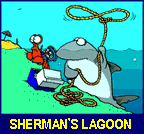
Sherman’s Lagoon: Finning Isn’t Funny exhibit at SF’s Aquarium of the Bay

San Francisco’s Aquarium of the Bay will be featuring a new exhibit featuring comic characters from Jim Toomey’s comic Sherman’s Lagoon, according to a press release.

The exhibit, “Sherman’s Lagoon: Finning Isn’t Funny,” focuses on the ecological threats posed by shark finning as told through the cast of the Sherman’s Lagoon. The exhibit will include comics, daily presentations, and “an action station where visitors of all ages can help prevent shark finning.” In addition, visitors to the exhibit can also sign individual letters to be mailed to National Marine Fisheries Service in support of international bans on finning.

The exhibit opens June 26, 2010. Jim Toomey will be at the aquarium on opening day to promote the exhibit, sign books, and conduct a “Cartooning 101” class. The exhibit will be open throughout the summer.

Update: Great white shark caught and killed at Star Island Yacht Club Shark Tournament

A relatively small white shark was killed on Friday during the Star Island Yacht Club Shark Tournament.

In a follow-up to today’s earlier post regarding internet rumors of a white shark being illegally caught and killed at the Star Island Yacht Club Shark Tournament, The East Hampton Press is reporting that a great white shark weighing between 300 and 400 lbs. (which would make it a relatively young white shark) was confiscated by the National Marine Fisheries Service after a participant in the Star Island Yacht Shark Tournament brought the shark in. (The great white shark has been a protected species in U.S. waters since 1997.) The article reports that the fisherman who caught the shark was neither fined nor arrested on the scene, according to Lesli Bales-Sherrod of the NOAA Office of Law Enforcement. However, he could face a civil charge at the conclusion of NOAA’s ongoing investigation of the event.

The East Hampton Press quoted Rich Janis, a manager of the shark tournament, as saying that the fisherman mistook the shark for another species. Janis went on to say that it was “an honest mistake” and noted that there was “no benefit” to the fisherman for bringing in the shark.

The information in the The East Hampton Press article is in stark contrast to the rumors that appeared on a few online angling forums, in which claims of an arrest, fines, boat seizure, and even a child endangerment charge were mentioned.

Great white shark caught illegally at Star Island Tournament?

Was a great white shark illegally caught and killed at the Star Island Yacht Club shark tournament?

UPDATE: It seems that there is some truth to the rumors about a great white shark being killed during the Star Island Yacht Club Shark Tournament. However, claims of the arrest, boat seizure, and fines against the angler seem to be unfounded, according to a report from The East Hampton Press. Additionally, more forum members at Noreast.com have since posted refuting the claims that any action was taken against the anglers involved in the catching of the great white shark.


According to threads on The Hull Truth Boating Forum and Noreast.com a fisherman at the Star Island Yacht Club Shark Tournament in Montauk, NY illegally landed and brought a great white shark into the docks. The great white shark has been a protected species in U.S. waters since 1997.

According to a forum member at Noreast.com, who participated in the tournament, a fisherman not caught a white shark, announced over his radio that he caught it, and then brought it in to the docks. The forum member went on to say that the man who caught the great white shark, was arrested, his boat was seized, and he was fined $25,000, in addition to being charged with child endangerment for bringing the white shark on the boat with a 6-year-old child on-board.

It should be noted that all of this information comes from user-submitted discussion forums. I have been unable to find any news outlets reporting this story at the time of this writing. Hamptons.com has an article on the shark tournament, but there is no mention of a great white shark being brought to the docks, nor any mention of charges brought against any tournament participants.