Author Archives: George Probst

About George Probst

George Probst is an award-winning American photographer best known for his underwater great white shark photography at Isla de Guadalupe. In addition to his work underwater, Probst travels to schools, businesses, and communities for public speaking events to discuss the importance of sharks and ocean conservation.

Amazing Great White Shark Sculptures by Bill Wieger

Not too long ago, I stumbled across a photo that somebody had posted one of my Facebook shark groups of an amazing great white shark sculpture, which I assumed to be from a museum. After doing a little digging and Google-ing (or is it Googling?), I managed to find the website of Bill Wieger, the amazing sculptor behind the the artwork. As it turns out, several of these incredible white shark sculptures are available for purchase through Wiegers’ online store. To top it all off, a portion of the sales from these awesome sculptures goes to the Guadalupe Island Conservation Fund.

Mystery 1, an amazing great white shark sculpture by Bill Wieger.gallery page.

The attention to detail in these white shark sculptures is stunning.

Mystery 1, an amazing great white shark sculpture by Bill Wieger.
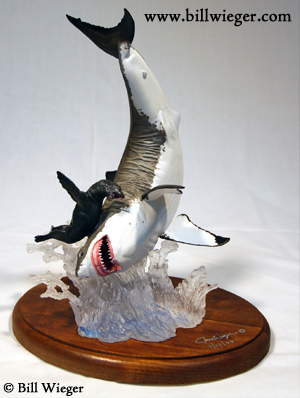

A sculpture of a great white shark breach by Bill Wieger.


In addition to be an artist, Wieger is also a shark diver. He believes strongly in animal rights and conservation. Along with the contributions to the Guadalupe Island Conservation Fund, Wieger donates proceeds from some of his other wildlife sculptures to the Dian Fossey Gorilla Fund, and to WildAid.

In addition to his white shark sculptures, Wieger also offers resin shark teeth cast from original white shark and Megalodon teeth. Wieger also has a selection of shark posters available.

If you’d like to see more of Bill Wieger’s work, or if you’re interested in purchasing one of his works of art, check out his website at www.billwieger.com.

All photos courtesy of Bill Wieger.

Rogue sharks to be hunted down, shot in the head, and have spine severed?!?!

File this one under “over the top” response. According to Perth’s The Sunday Times, Western Australia Government’s Shark Hazard Committee has revealed revealed a plan of attack for dealing with “rogue sharks.”

According to Tina Thorne, WA Department of Fisheries strategic compliance manager, the series of actions for dealing with rogue sharks would involve hooking an offending shark on a baited drumline, hauling it aboard a boat, shooting it in the head, and then “severing its spinal cord and bleeding it out.” Thorne stated that these measures would be a “last resort” and only take place in extreme circumstances involving a rogue shark attacking a human and continuing to pose a significant threat to humans, AND the attacking shark would have to be positively identified. Thorne also stated that since white sharks are a protected species that “a special exemption from the law was required by Fisheries Minister Norman Moore to kill one.”

Great white sharks are a protected species in WA, and special exemption from the law would be required to hunt one down.


In 3 of the last 4 fatal shark attacks in WA, the shark responsible was never spotted. Only in the case of an attack on Brian Guest did the shark remain in the area after the attack. According to The Sunday Times article, Guest’s family was angered by the Shark Hazard Committee’s recent talks of killing sharks. A friend of the Guest family said that Guest’s wife and son stood by the idea that “sharks belong in the marine environment and should not be harmed.”

While I certainly believe that protecting humans from shark attacks is a serious and important issue. The idea of hunting a specific shark down, shooting it in the head, severing its spine, and bleeding it out seems so ridiculous that I would expect to find the idea in a really bad shark-themed horror movie. Instead, we find the idea coming from a government committee assigned with the task of dealing with real-world shark attacks. Even Ms. Thorne’s comments seem to indicate that the circumstances that would result in this method of response ever occurring seemed highly unlikely. Based on The Sunday Times article it seems like the only time these measures would be considered would be if a shark similar to the one in a certain famous shark movie showed up, attacked a human, and then continued to terrorize a beach area. I guess anything is possible, but I wonder why there was no mention of hiring a local crusty shark hunter to get the job done. I guess they didn’t want him interrupting the Shark Hazard Committee meeting by scratching his fingernails on the chalkboard.

Battle for best (ok, worst) giant shark movie on YouTube

Australia’s Courier Mail has an interesting and amusing story about the battle of “giant shark movie” clips that is currently raging on YouTube. The contenders are the trailer for Mega Shark vs Giant Octopus, and a short excerpt from Shark Attack 3: Megalodon (which the Courier Mail incorrectly refers to as a “trailer” for the film). When it comes to view count, the Shark Attack 3: Megalodon clip is the winner hands down with over 17.5 million views, compared to Mega Shark vs. Giant Octopus’ 2.1 million views. In all fairness, the Shark Attack 3: Megalodon clip has been on YouTube for 2 years longer than the Mega Shark vs. Giant Octopus. View counts aside, though, which is the king of the giant shark movie?

The tale of the tape goes something like this…

Mega Shark vs. Giant Octopus features:

  • Acting sensations Lorenzo Lamas and Debbie Gibson (oops, DEBORAH Gibson)
  • State-of-the-art computer-generated special effects that look like they came right off your 1996-era Nintendo 64 (you know you want to click the link)
  • A shark attacking the Golden Gate Bridge
  • A giant octopus knocking a fighter plane out of the sky
  • A shark attacking a passenger jet
  • No seriously, A SHARK ATTACKING A FREAKING PASSENGER JET!!!

Shark Attack 3: Megalodon features:

  • Dazzling special effects involving actual white shark footage with actors superimposed into the footage for incredible “realism”
  • Some of the most infamous dialog ever featured in modern film
  • No appearances by either Lorenzo Lamas or Debbie Gibson

With each film having such unique strengths, it’s hard to pick a clear-cut winner (although Giant Shark vs. Mega Octopus does have a shark attacking a passenger jet!!!). I guess the only solution is to let you judge for yourselves. I’m going to go watch the true king of YouTube videos.

September Outer Banks death ruled accidental drowning, not shark attack

According to the Virginia Pilot, the death of a Pennsylvania man, who was vacationing at North Carolina’s Outer Banks last September, has been ruled an accidental drowning, according to the final autopsy report. The initial autopsy indicated that the man had died as a result of shark bites.

In October, reports surfaced that the cause of death had been changed , but a statement from East Carolina University, where the autopsy occurred, said that the “continued uncertainty” would require that the case be further reviewed. According to the Virginia Pilot article, doctors reviewed the case with marine biologists and concluded that “death was likely not due to shark attack.”

Regardless of the cause of death, a loss of life is always tragic. Hopefully, now that the autopsy report has been finalized, the family and friends of the victim can have some closure in this case.

Institute for Ocean Conservation Science video on shark fin tracking

The Institute of Ocean Conservation Science (at Stony Brook University has posted a new video to their YouTube channel. The video was created by the American Museum of Natural History and focuses on research by the IOCS involving genetic tracking to identify the geographic origins of shark fins sold in Hong Kong. The goal of the research is aimed at aiding international trade agencies in determining how to protect fish species.

2010 starts off with the return of the “monster shark” to the news

The Courier Mail is starting off 2010 with a spin-off story involving the “monster” great white shark reportedly responsible for a shark-on-shark attack on another great white back in October. As everybody knows, sequels generally don’t live up to the original, but that hasn’t slowed down the Courier Mail. According to the article, surfer Russell Specht survived a “terrifying” encounter with a “monster” white shark off of Main Beach, North Stradbroke Island (Queensland, AUS). The article also states that Specht, local lifesavers, and boardriders fear that this was the same shark responsible for the “horrifying” shark-on-shark attack in October. Specht, who described the animal as approaching “like a submarine,” estimated that the shark was at least 4m (13′) in length. Four other surfers were with Specht when someone spotted the shark (or “monster” as it is referred to in the article). Specht’s mates immediately headed toward the beach leaving him alone in the water with the approaching shark. Specht said the shark passed directly underneath him, as he sat motionless on his board, at a depth of about 1m (3.3′) before veering off and swimming away.

Some more non-monster great white sharks. At least, I don't think these are monster sharks.


The article goes on to mention that the co-ordinator of Surf Life Saving Queensland Gold Coast services, Stuart Hogben, supports Specht’s suspicions that he saw the same great white shark responsible for the shark-on-shark attack in October. However, neither Hogben nor the article’s author make mention of any evidence as to why they believe this is the same shark, other than to say that Hogben witnessed several sharks in the 2-3m range about 200-300m offshore of the island’s surf side, during a helicopter flight last weekend.

The Courier Mail has pulled out all the stops with this story. It’s filled to the brim with sensationalism. The author throws in words like “terrifying,” “horrifying,” and “monster.” The story seems crafted to play up the fear angle that was also exploited when the initial shark-on-shark attack story broke, yet this story fails to contain any facts or evidence to support the theory of Specht and Hogben. There is no mention of the discrepancy in the size of the shark believed to be responsible for the shark-on-shark attack compared to the size of the shark Specht encountered. The estimated size of the shark involved in the October attack as being 5-5.2m (16.4-17′), according to Queensland Primary Industries and Fisheries manager, Tony Ham. Ham’s team estimated the shark’s length based on the bite wounds to the shark carcass from the October attack. Specht, on the other hand, reported the shark he saw as being at least 4m (13.1′). Granted, the term “at least” does leave some wiggle room for the shark’s actual size, but we’re talking about a difference of at least 1m (3.3′).

Then there’s this whole issue of “monster” sharks. A 4m white shark is certainly a large shark when compared to the size of human, but for a species known to reach lengths of 6m (19.7′), it escapes me how the shark that Specht saw has achieved its “monster” status. Perhaps, the “monster” title is independent of size. However, if that were the case, it would seem that the “monster” status would have to be earned based on monstrous behavior. In the case of Specht, the only thing the shark reportedly did was swim in close proximity of Mr. Specht and some other surfers, which hardly seems to be monster-worthy activity. Despite the lack of any real confrontation between the shark and Specht, the Courier Mail article is adorned with a headline that mentions a “face-off” between Specht and the shark. Since there was fortunately no reported confrontation between the shark and Specht, we can only assume that the two were beginning a friendly game of hockey. Now, THAT would be a newsworthy shark story.

Real-time alerts to be sent when tagged white sharks approach Perth beaches

The New Zealand Herald is reporting that the West Australian Department of Fisheries is in the process of installing 20 acoustic receivers along the coast of Perth, Australia which will output a signal any time a tagged great white shark travels within 500m of one of the receivers. After a white shark is detected by a receiver, an alert will be sent either via email or text message to notify government and wildlife officials about the shark’s presence. Lifeguards and scientists will also be contacted through this alert system.

Tagged white sharks will send out an alert when they are within 500m of receivers at West Australia beaches.


A two-year, $400,000 (AUS) study will be performed, using this technology, to track movement of white sharks along the coast of Perth. According to the article, over 70 sharks have already been tagged, and the acoustic receivers will all be installed by February in the seabed around popular beaches. The goal of the program is to better understand white shark behavior around beaches.

The New Zealand Herald loses points for opening the story with a Jaws reference and referring to 100 sharks as being “man-eating.” Other than first paragraph, the story remains fairly objective, though.

A happy ending to a shark being caught by a fisherman?

YouTube user sherri7057 has posted a series of short video clips that involve a fisherman accidentally hooking a shark. According to the video information the fisherman was fishing for tarpon at Sanibel Island, Florida. While there isn’t anything particularly dramatic or spectacular about a fisherman accidentally hooking a shark, the final video of the sequence might be indicative of a more positive perception of sharks from the public. Not only does one of the guys make an effort to pull the shark back into deeper water, so that it can swim away, but a group of people can be heard in the background cheering and applauding when the shark is successfully released.

Kudos to the guy who helped the shark back out into the water!