Author Archives: George Probst

About George Probst

George Probst is an award-winning American photographer best known for his underwater great white shark photography at Isla de Guadalupe. In addition to his work underwater, Probst travels to schools, businesses, and communities for public speaking events to discuss the importance of sharks and ocean conservation.

Mutts comic strip addresses declining shark populations

In the past few days, Patrick McDonnell’s “Mutts” comic strip has been following the perils of “Tony the Shark.” In the comic strip, Tony has been expressing his fears to his crab buddy, “Crabby,” about finning and “shark killing tournaments.” The recent entries in the comic strip are a clever play on the role-reversal of sharks having more to fear from humans than humans having to fear from sharks.

Legally, I can’t re-post the comic strip here on the blog without paying for reprint rights, so I’ve included some links to the comic from the Seattle P.I. below…

Mutts – August 10, 2009
Mutts – August 11, 2009
Mutts – August 12, 2009
Mutts – August 13, 2009
Mutts – August 14, 2009

Mutts is currently featured in over 700 newspapers and in 20 countries. It’s always good to see the issues of finning, overfishing, and declining shark populations being addressed in a form of media across such a wide audience. Kudos to Patrick McDonnell for addressing shark conservation in Mutts. For more information about Mutts, visit the Offiicial Mutts Website.

Whale sharks off of Drayton Beach, Florida

According to the info associated with this video, five whale sharks have been spotted in the area off the coast of Drayton Beach, Florida this month. The video was shot by James Griffith of Santa Rosa, Florida. Unlike another recent whale shark video, the divers in this one manage to avoid direct contact with the shark(s), although somebody aboard a boat does reach out to “pet” a passing whale shark at one point. At one point in the video, even the dog aboard the boat seems captivated by a passing whale shark.

Bull shark hitches a ride on a boat

In a freak occurrence a bull shark jumped aboard a boat off the coast of Florida.

In a freak occurrence, a bull shark jumped aboard a boat, off the coast of Florida.


A 5.5′ (1.7 meter) bull shark accidentally found itself aboard a fishing boat over the weekend, off the coast of Florida, according to MyFox Boston.

The shark jumped into Michael Powers’ 21′ boat off the coast of Haulover Beach. Powers and multiple passengers were returning from a day of spear-fishing and lobster diving, when the shark breached the surface and landed on the deck of the boat. The shark injured herself while flopping around on the deck sending some of the passengers on board scrambling to get out of her way. Eventually the crew of the boat was able to return the shark to the water. Fortunately, the crew and passengers aboard the boat were all unharmed.

This sounds like one of those freak occurrences when a shark breaches the water at the wrong time and, in this case, ends up on-board somebody’s boat. The story reminds me a bit of the spotted eagle ray fatality in Florida that occurred last year. From the eyewitness reports, the shark was on the receiving end of most of the trauma.

Fortunately, this story has been covered fairly objectively in the media, from what I can tell, and I haven’t really seen many media outlets over-sensationalizing this. Shark Leaps into Boat in Florida, Scares Fishermen, from Associated Content, does get a little carried away with the statement, “They all came face to face with a shark that would have torn them apart if they hadn’t scrambled to get out of the way.” From all accounts, the shark was flailing as a result of accidentally landing in a boat. While a flailing bull shark certainly poses a safety threat, it’s a bit of a stretch to say that the shark would have torn anybody apart.

Dead sharks draw a crowd (just imagine what live ones could do)

Sharks lure a crowd, according to a recent article from the Pensacola News Journal about the “Outcast Mega Shark Tournament.” The article states that about a thousand “shark-crazed” fans attend the tournament to “see big sharks” among other reasons. Tournament director, Terry Holmes, says it’s the mystique associated with sharks that brings in the spectators…

“They’re dangerous. They eat people, and people like that.”

I’m hoping the part about people liking that sharks “eat people” was a misquote. It’s incredibly rare for a shark to eat a person. Even in the rare event of a shark attack on a human, a shark typically does not eat a person, nor would I expect other people to “like that” if they did.

The article also featured quotes from spectators who were there to see sharks “up close.” One spectator who witnessed the weigh-in of 399 lbs hammerhead was quoted as saying…

You know they’re out there in the waters, but you don’t ever really get to see them. They’re so magnificent, and you’re seeing ’em up close.”

Now, just imagine if you saw them up-close…and they were still alive. They really do look much more magnificent when they’re swimming around, than they do when their carcass is hoisted up in the air by its tail. The reality of it is that it’s simply not easy for most people to witness sharks in their natural environment, and many people have underlying fears of snorkeling, diving, or swimming with sharks. Unfortunately, the most readily-accessible option for some “shark fans” to see sharks is at a shark-fishing tournament.

Shores of Silence – Whale Sharks in India – available for viewing on-line in its entirety

The award-winning whale shark documentary, “Shores of Silence,” is available for viewing online at TheUnderwaterChannel.tv. The film, which was directed and financed by Mike Pandey, documents the mass hunting of whale sharks off the coast of Gujarat, India. Click to watch “Shores of Silence” (Warning: this documentary chronicles the capture and butchering of whale sharks.)

When the film was shot, whale sharks were not protected in India’s waters under the Wildlife Act of 1972, allowing the slaughter of the animals to go unregulated. While the film does feature footage that might be difficult for some to watch, it had such an impact that the government of India introduced legislature protecting the whale shark in 2001. Aware that legislation protecting whale sharks would have a detrimental financial impact on the fishermen who hunted them, Pandey also explored ways that the fishermen could earn a living as guides for whale shark tourism targeted toward tourists and divers interested in seeing the animals in their natural habitat.

The big thing that jumps out at me about this documentary is that, while Pandey clearly is against the hunting of whale sharks, he does touch on the livelihood of the fishermen who hunt them and does not turn a blind eye to their need to sustain themselves and their families. Pandey points out that the fishermen, who actually expose themselves to the risky whale shark hunts, actually do not make a lot of money off of their kills, while exporters reap about 40x as much financial gain as the fishermen in the southeast Asian markets. Pandey is not so one-sided that he is only concerned about the welfare of the whale sharks while ignore the welfare of those who make a living off hunting them. His ideas of preserving the whale sharks and turning Gujarat into a whale shark tourism site is a win-win situation for the fishermen and the sharks.

For more information about the film visit Shores of Silence – Green Oscar winner at Wildscreen at UnderwaterChannel.tv.

What if humans were portrayed in the media the same way sharks often are?

I’m often left dumbfounded at the way some media outlets cover “news” stories whenever there is a shark involved in the story. Somehow, the movie, Jaws, seems to work its way into the news, often times simply because a shark is mentioned in a news story. News reporters and anchors often make remarks about their fears of sharks and further reinforce negative stereotypes about sharks with off-the-wall comments. So, what would “the news” be like if the tide was turned and humans were treated the way that sharks are often treated in the media? Let’s head to the coast of Britain for our story (the actual story can be found at Diver photographed in close encounter with shark)

Now entering the alternate media world…


Sharks escape close encounter with masked humans

On July 13th, two basking sharks survived a harrowing close-encounter with not one, but two humans! The sharks involved were simply out for a swim near their home off the coast of Cornwall, when they spotted the two humans lurking in the water. While humans are typically much smaller in size than basking sharks, they have become quite adept at killing sharks and other prey items much larger than their own size. When the sharks drew closer to the humans, the smaller beasts suddenly became motionless. Humans have been known to remain motionless when hunting, in order to ambush unsuspecting prey. The humans were also said to be wearing masks of some kind, not unlike the killer humans found in movies such as Friday the 13th, The Texas Chainsaw Massacre, and Halloween.
Humans are the same species as the psychopathic killers found in popular horror movies.

Humans are the same species as the psychopathic killers found in popular horror movies.


While not all humans are considered dangerous toward sharks, humans were responsible for the deaths of an estimate of millions of sharks last year. Fortunately, for the two basking sharks, the humans that they encountered were not interested in cutting off their fins and leaving the sharks for dead. Instead, the humans merely took a photograph of one the sharks and allowed them to leave unharmed.


Back to reality…

It seems utterly ridiculous when you read it, doesn’t it?

Dispelling the fear that Shark Week is selling and circumventing ignorant reporting

Rockford Illinois’ WREX Channel 13 ran an interview with Shark Diver Magazine’s Thomas Sergent yesterday. Sergent attempted to dispel the fear campaign that Discovery Channel has been serving up with this year’s Shark Week. (WARNING: The video does feature a few brief scenes of finning and a couple of shots of dead white sharks)

Sergent’s message was conservation-oriented and focused on how sharks have more to fear from humans, than we have to fear from them, based on the number of sharks killed annually by humans. However, that didn’t stop reporter, Bob Schaper, from interjecting an utterly ignorant statement into his interview with Sergent, which basically undermined the very message Sergent was trying to convey…


“Let’s face it. There are some sharks that like to gnaw on you, and, you know, just like drag you down and eat you, and chomp on you.”

There really isn’t any excuse for statements like this in what is supposed to be an objective news report. Not only does the statement reflect a sense of bad reporting, it is counterproductive to the intended message that Sergent was trying to communicate. The sheer lack of common sense of the statement makes me wonder if Schaper was playing “devil’s advocate” and began the statement with something to the effect of, “What do you say to people who think…” and that part was edited out. That scenario would at least make some sense.

White shark sighting in the Gulf of Mexico?

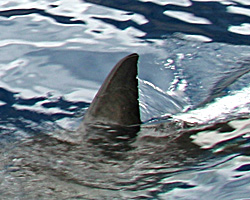
The dorsal fin of a white shark. Fishermen in the Gulf of Mexico witnessed a similar sight on July 25.

The dorsal fin of a white shark. Fishermen in the Gulf of Mexico witnessed a similar sight on July 25.

According to the article, “Great White Shark Sighted Near Orange Beach”, the captain and crew aboard Chipper’s Clipper witnessed what they believed to be a great white shark on July 25. The shark was seen about 40 miles southeast of Orange Beach, Alabama in the Gulf of Mexico. Captain Chip Day first spotted the shark about 200 feet from the boat. He initially thought that it was a mako, but as it got closer, he and fisherman, Joe Pruett, “were able to observe the jagged line separating the gray from the white on the shark’s body. It was then they realized they’d just had a close, rare encounter with a Great White Shark in the Gulf of Mexico.”

Pruett, who had served in the Navy and spent time in the Pacific, said he had seen a number of great white sharks, and the shark they witnessed in the Gulf “looked just like” the white sharks he had seen during his time in the Navy. Day, who has been fishing in the Gulf for 30 years, had seen numerous mako and bull sharks, but this was the first time he’d ever had an encounter with a white shark.

A picture of the shark’s dorsal fin, as well as, a shot of the shark taken from the surface are featured with the original article. Was this a rare encounter with a great white in the Gulf? Check out the pictures and the story to see for yourself.

Is this “putting all of your media weight” behind shark conservation?

Above is the currently featured promotional video for Shark Week from Discovery Channel’s official YouTube page. It starts off with a series of shark attack depictions that rival those found in the movie, Jaws. If Discovery Channel is truly committed to putting “all of their media weight” behind the effort “of educating viewers about the plight of sharks and encouraging them to take action,” as Discovery Channel president, John Ford claims, why do they continue to feature promotional videos that focused predominantly on shark attacks on humans. Did I miss the conservation angle in this video?

CBS segment on “saving sharks”

The Early Show on CBS ran the video segment below this morning in conjunction with Discovery Channel’s Shark Week. The segment is loaded with all the typical shark cliches that often accompany mainstream media reports, including Jaws theme music, the science and technology correspondent referring to himself as bait, and the entire morning crew getting a good laugh in about sharks having “a tough PR problem.” While the lead-in to the video mentions sharks being endangered, the focus of the segment doesn’t seem particularly rooted in conservation efforts, and the light-hearted attitude on the part of the crew back in the studio at the end of the segment really doesn’t convey to me that those involved with the show treated the declining shark population issue with much serious thought.

The segment is not completely without merit, in terms of shark conservation, Andy DeHart, of the National Aquarium, notes that 250,000 sharks are killed daily, and he discusses the impact that losing sharks would have on the marine ecosystem. Stuart Cove also brings up how the experience of diving with sharks can change opinions and attitudes about sharks. Although, with the controversy going on with shark diving in the Bahamas, this Tiger Beach footage in the segment might also drum up more criticism from those opposed to shark diving.

A text-based version titled, Making A Case For Saving The Shark, also appeared online today.