Author Archives: George Probst

About George Probst

George Probst is an award-winning American photographer best known for his underwater great white shark photography at Isla de Guadalupe. In addition to his work underwater, Probst travels to schools, businesses, and communities for public speaking events to discuss the importance of sharks and ocean conservation.

A pair of shark attacks over the weekend

According to West Palm Beach, Florida’s WPTV.com, a Florida teen was bitten by a bull shark on Friday while spear-fishing in the Bahamas. Derek Mitchell was spear-fishing off Spanish Cay with his father and some neighbors. One of the other spear-fishermen had speared a fish, which they believe attracted the shark’s attention. The bull shark approached Mitchell but initially turned away, before returning and biting his lower leg, puncturing his Achilles tendon. Mitchell was rushed to a local hospital and later flown to St. Mary’s Hospital in West Palm Beach for surgery. Mitchell is expected to recover from the attack, according to the report.

In other shark attack news from the weekend, New Orlean’s The Times-Picayune article, Coast Guard medevacs man bitten by shark in Breton Sound, reports that, on Saturday morning, a fisherman was bitten in the leg by a shark. The victim was fishing about 65 miles southeast of New Orleans, in Breton Sound. The victim was airlifted from the scene by a Coast Guard MH-65C dolphin rescue helicopter and taken to New Orleans, where he was transported to University Hospital. The victim, from Mississippi, had not been identified, and the report listed his condition as unknown.

The Coast Guard has posted this video footage of the rescue.

Update (08/03/2009): WWL.com is reporting that the victim of the shark attack in Louisiana is 62-year old Chris Haynes. Haynes was bitten as he was wading in the water, while fishing in Breton Sound. According to Coast Guard Lt. John Egan, the shark “took off about half of his foot.” Egan also said that Haynes is “doing okay” and was to undergo surgery today (08/03) “to help fix up his foot and his leg.”

Here’s to hoping for a speedy recovery for both Haynes and Mitchell.

Renowned chef, Alice Waters, makes No Shark Fin Pledge

The No Shark Fin Pledge discourages the serving and consumption of products made with shark fins

The No Shark Fin Pledge discourages the serving and consumption of shark fin products

In a press release from The Humane Society of the United States, it is being reported that renowned chef and author, Alice Waters, has signed The International Humane Society’s No Shark Fin Pledge, which reads…

I pledge to help protect the world’s oceans by committing never to consume or serve shark fin or any product containing shark fin.

Continue reading

Media outlets reporting false shark attack fail to follow up with the true story

It’s been over a week since an incident involving an 11-year-old girl being bitten by a bluefish was falsely reported as a shark attack by multiple media outlets. Within less than 24 hours after the “story” broke, an AFP release revealed that “maritime experts later concluded that the bite suffered by the girl was too small to have been caused by a shark and was compatible instead with the marks that would be left by a bluefish.”

False accusations against a blue shark persist.

False accusations against a blue shark persist.

While it’s not uncommon for details of breaking news to be sketchy, if not entirely inaccurate, most media outlets tend to follow-up on a story when it turns out the story has been falsely or incorrectly reported. However, that doesn’t appear to be the case with the following publications:

Continue reading

Shark articles appear from…err, Popular Mechanics?

I’ll admit that Popular Mechanics isn’t really a media outlet where I would expect to find an objective piece about sharks, but today, two shark-related articles showed up on their website.

Marine Biologist Debunks Common Misconceptions About Sharks is a Q&A session between Popular Mechanics reporter, Erin McCarthy, and Andy Dehart of the National Aquarium. The session deals with misplaced fears, misconceptions about shark diets, and, of course, the declining numbers of sharks worldwide. One encouraging note is that Dehart says, “that the general public is more and more educated about sharks and shark issues.”

The second article, Survive Anything: How to Escape a Shark Attack, discusses how to avoid and escape a shark attack, as unlikely as one may be. The article does mention that there “are approximately 40 shark attacks” in the waters surrounding the U.S. each year. However, I wish it would have mentioned that percentage of those that are serious or fatal. Even though 40 attacks a year, for the entire U.S. coastal areas is still a relatively minuscule number, I think there are people who see the words “shark attack” and automatically assume a fatal attack. The article does go on to mention that you’re more likely to be struck by lightning than to be involved in a shark attack, though. As for the survival tactics, which are offered by George Buress, Director of the Florida Program for Shark Research, they can be broken down into three simple rules…

  1. Be aware of and recognize the signs of aggressive shark behavior. (The article lists hunched back, lowered pectoral fins, erratic swimming, and yawning but fails to mention that these behaviors are not universal to all sharks.)
  2. If you see a shark displaying signs of aggression leave the area “quickly but smoothly” while maintaining visual contact with the shark.
  3. In the rare event that an attack does occur, fight back. (The article mentions the “classic” nose punch as a good defense to buy time to get out of the water.)

All-in-all, the Popular Mechanics articles remain fairly objective and offer up some worthwhile general information to the reader.

Time Magazine article on sharks and media frenzy

Time.com has an article up (interestingly it’s currently dated at August 10, 2009, which I’m guessing is the date it will appear in print) titled, Threats with Teeth. The article, written by James Poniewozik, discusses how the media focuses on media overkill and uses the media (over-)reaction to “minor shark attacks” in the summer of 2001, which the media dubbed “Summer of the Shark” as an example.

Poniewozik likens “living every week like it’s Shark Week” to dealing with our current media environment…

To live every week like it’s Shark Week, then, might be a metaphor for living in our media environment: to spend every week titillated by unlikely threats, getting whipped into frenzies, yawning over high-minded stuff like health-care policy and supping from the delicious chum bucket of hysteria.

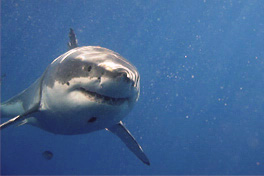
A completely non-threatening white shark

Seriously, now, does this look threatening?

I think Poniewozik is pretty well on-point with the article, and I agree that it seems like society seems more concerned with sensational-yet-unlikely threats than the more boring-yet-likely ones. The news media is a big money-making industry, and at the end of the day, fear of the unknown and unlikely sells. Threats like automobile accidents on the way to the beach, drowning, over-exposure to the sun, bee stings, and jellyfish stings are far more likely to result in the death of a beachgoer than a shark attack, but those other threats are all so passe, in the eyes of the media, compared to the thought of a shark biting someone. As Poniewozik sums it up in the closing paragraph of the article…

…that one-in-a-million chance of being done in by a primeval predator from the murky depths–that’s the threat with teeth.

Exploiting great white sharks to draw attention to a news article

Despite having “great white sharks” in the title and a photo of a breaching white shark as a lead-in, the Telegraph article, Sunbeds now seem to be as deadly as great white sharks , has little to nothing to do with great white sharks, at all. It merely serves as a reminder that there are people in the media who will use sharks to grab the attention of a potential audience. (Yes, the article even suckered me in with the title.)

What do white sharks have to do with sunbeds? Nothing at all.

What do white sharks have to do with sunbeds? Nothing at all.

The only mention of great white sharks in the article occurs when author, Bryony Gordon, states, “This week, the World Health Organisation warned that sunbeds are as dangerous as cigarettes and asbestos, which is to say very, very dangerous, almost as dangerous as the great white shark, or lying down in front of a steamroller.”

Actually, Mr. Gordon, statistically-speaking, great white sharks are far less dangerous than cigarettes or asbestos. If you were to compare the number of cancer-related deaths attributed to sunbed use, cigarette use, or asbestos exposure to the number of human deaths caused by white sharks, I think you would find the number of deaths caused by white sharks to be negligible in comparison. The U.S. CDC reports the annual number of deaths due to cigarette use at 440,000 a year, in the U.S. alone. Annual asbestos-related deaths in the U.S. were estimated at over 14,000 in 2002 and are expected to continue to rise. In contrast, the annual number of deaths GLOBALLY, due to white shark attacks, is routinely in the single digits. So, Mr. Gordon, cigarettes and asbestos are not “almost as dangerous as the great white shark.” They are far more dangerous.

I wasn’t able to find any stats on lying down in front of a steamroller, so I apologize to the steamrollers of the world, if you’re being unjustly associated with cigarettes, asbestos, and sunbeds.

Anti-finning “performance display” at Lush cosmetic stores

Real Business’ Lush hooks customers with gruesome window display reports about an anti-finning window display appearing at Lush cosmetics stores. According to the article, a former Lush employee and performance artist, Alice Newstead, has been painting herself silver and hanging herself from the ceiling in “a dramatic illustration of shark finning.” The display is part of a campaign between Lush and Sea Shepherd to end overfishing.

Newstead first appeared in the display in London last year…

The display appeared in Paris earlier this month, and the next stop is New York City.

A woman being suspended by hooks from the ceiling of a cosmetics store is certainly a “unique” way to promote shark conservation, to say the least, but it does seem like the display is grabbing the attention of people. Hopefully, that attention will, in turn, lead to an increased awareness about the rapidly declining number of sharks, due to finning and over-fishing.

New York Times editorial on declining shark numbers

An editorial, The Death of Sharks, which appeared in print on July 29, 2009, on page A22 of the New York edition, focuses on the declining number of sharks due to finning and overfishing.

The editorial addresses the negative impacts of removing sharks as apex-predators from the marine eco-system:

“The species whose numbers the sharks once controlled begin to explode; they then wipe out smaller fish, some of which humans depend on for food. Water quality suffers. Healthy oceans require sharks, and without healthy oceans, healthy fisheries are impossible.”

Seeing editorials like this one appear in major U.S. media sources is encouraging, as it helps to promote awareness of the threat of extinction of many of the oceans sharks species. Hopefully, we will continue to see media coverage that focuses on shark conservation, as opposed to over-sensationalizing shark-related stories.

“Violent and dangerous” hammerhead sharks spotted in the sea!

In a prime-example of media sensationalism, The Korean Times is reporting in the article, Vacationers Warned After Sharks Spotted, that two hammerheads were spotted off the coast of Tongyoung, South Gyeongsang Province “not far from” Mondol Beach. The article quotes a researcher of the National Fisheries Research and Development Institute as saying, “the hammerhead shark is a violent and dangerous species,” and “Our beaches are no longer safe from sharks.”

Hammerhead sharks: a dangerous and violent species?

Hammerhead sharks: a dangerous and violent species?


Continue reading

Discovery Channel president admits to “playing with people’s fears”

A Cleveland.com article, Shark Week about to begin on the Discovery Channel, discusses how “the Discovery Channel every year charts a tricky course between exploiting our fear of sharks and demythologizing them.” The article makes the statement, “If ever an animal was burdened with an image problem, it’s the shark.”

Sharks like this white shark are facing an image problem, largely due to media portrayals of sharks as mindless man-eaters.

Sharks like this white shark are facing an image problem,
largely due to media portrayals of sharks as mindless man-eaters.

The article goes on to quote, John Ford, president and general manager of Discovery Channel, as saying the following…

“We do play off the fear to some degree.That’s good marketing. But we also give people solid information, and viewers understand that. We play with people’s fears, but we ultimately allay them. One thing we do is run regular public service spots about dangers facing shark populations. After all, if sharks could experience fear, they would be much more fearful of us.”

I wonder if by “us,” Ford meant humans, in general, or the Discovery Channel. Running public service announcements about the decline in shark populations during programming that is promoted primarily by media campaigns featuring fictitious shark attacks on humans (and even dogs) hardly makes sense (although, it will likely make plenty of “cents” for Discovery).